Happy Glass

What Is Happy Glass?
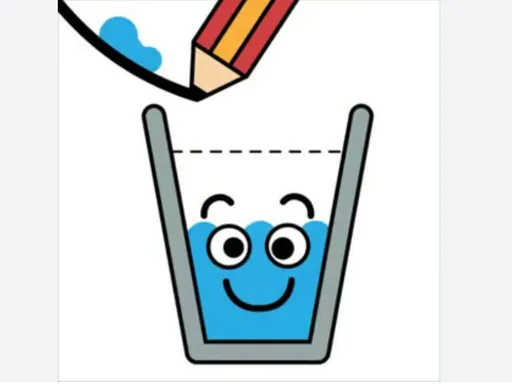
Happy Glass is a browser-friendly physics puzzle where you draw lines to steer water into a sad cup, clear the stage, and turn its frown into a smile. A sad empty glass sits on the stage, a water source appears above or to the side, and you get one simple tool: draw a line. That line can become a ramp, a barrier, a funnel, or a brace that changes how the water falls. When enough water reaches the fill mark, the face on the glass changes and the level ends. The objective is easy to read in seconds, but the path to success keeps shifting because angle, gravity, and timing all matter.
Most levels are short, which is a big reason the game works so well in a browser. You can test an idea quickly, see exactly where the water escaped, and try a solution right away. Some stages ask for a direct route, while others reward a line that slows the stream, protects the rim, or nudges droplets around awkward ledges. That balance between clarity and experimentation gives Happy Glass its identity. It feels friendly at first glance, but it still rewards careful thinking.
How a Typical Stage Unfolds
The first step is reading the level before drawing anything. Look for three things: where the water starts, where the glass can safely receive it, and what obstacle is most likely to waste droplets. In many early stages, the answer is a smooth descending line that guides the stream into the cup. Later puzzles complicate that idea with moving elements, gaps, uneven platforms, or placements that tempt you into overbuilding.
If you want a quick feel for the browser version, Happy Glass shows why the concept remains effective online. The best solutions are usually smaller than your first instinct. A compact line near the source often does more than a huge barrier near the cup, because the game cares about flow, not decoration. Once you start noticing that pattern, tougher stages become easier to read.
Controls That Stay Out of the Way
On desktop, you click and drag to sketch your line. On phones or tablets, you tap and drag with one finger. That is almost the entire control scheme, which keeps the focus on planning rather than button combinations. Because the action is so direct, browser play feels natural: draw, release, watch the water react, then retry if your idea was slightly off.
What Success Usually Looks Like
A clean clear does not always mean drawing the longest line or sealing every opening. It means giving the stream a stable first contact point and a clear final landing. If the first few droplets go the wrong way, the rest often follow. If the area around the rim is too crowded, the water may bounce out at the last second. Winning solutions tend to look calm and economical, even when the puzzle itself is tricky.
Playing It Smoothly in Your Browser
On this site, the browser format makes Happy Glass easy to start and easy to revisit. There is no long setup, no complicated onboarding, and no need to remember a deep control chart. You load the page, begin drawing, and learn through visible results. That quick loop is perfect for a puzzle game where each stage is essentially a physics question with a visual answer.
Mouse control is especially useful when a level needs a narrow slope or a short support line at a precise angle. Touchscreens feel good too because the motion of sketching a path matches the core fantasy of the game. Whether you are on a laptop during a short break or on a phone for a few quick puzzles, the browser version keeps the same appeal: low friction, fast retries, and just enough challenge to make a solved level satisfying.
Practical Tips That Save More Water
Let gravity do most of the work
Players often fail by trying to overpower the level with giant drawings. Instead, think about redirecting rather than forcing. A slight slope can carry the whole stream where it needs to go. A short guide line can prevent a spill that looked inevitable. When the game gives you water and a cup, gravity is your main ally, so cooperate with it instead of fighting it.
Protect the cup without blocking it
It is tempting to build a fortress around the glass, but that can create new problems. If the opening is too cramped, droplets hit the rim and scatter away. The better approach is to leave the glass enough room to receive water while only covering the side that is truly exposed. In other words, keep the landing zone clear while still guiding the stream.
Change one detail at a time
When a solution almost works, avoid replacing the whole drawing immediately. Shorten one endpoint, soften one angle, or move the line closer to the source. Small changes teach you why the stage failed. That habit is also the fastest way to improve, because you stop guessing and start observing. Happy Glass is at its best when each retry gives you a new clue.
Watch for fake simplicity
Some of the hardest levels look easy because the objects are few and the cup is visible. The trap is usually in the route the water takes after the first bounce. If a puzzle seems obvious, pause for one extra second and imagine the first drop, the midpoint, and the final landing. That tiny bit of planning prevents a lot of avoidable restarts.
From Mobile Hit to Long-Running Casual Favorite
Happy Glass is closely associated with Lion Studios on the official mobile store listings, which describe the game with the same core pitch: draw lines freely, fill the glass, and aim for better solutions. The Android listing still presents it as a casual single-player puzzle with a massive install base, while the iOS listing credits Lion Studios and carries a 2019 copyright notice. That history matters because it explains why the design feels so polished. The game was built for wide accessibility from the start, then proved flexible enough to work beyond mobile storefronts.
The lasting appeal comes from how expressive the puzzle space is. Two players can look at the same stage and solve it with different shapes. That gives the game replay value even when the rules are simple. It also makes browser sessions rewarding, because you are not just finding the correct answer; you are discovering a solution that makes physical sense in motion.
FAQ
Is Happy Glass free to play in a browser?
Yes. The browser version is designed for instant play, so you can jump into levels without a traditional install flow.
What kind of game is Happy Glass?
It is a physics drawing puzzle. You create lines that change how water moves so the glass fills to the target mark.
How do I control the game?
Use a mouse on desktop or touch input on mobile to click, tap, and drag your line into place. The controls are intentionally simple.
Why do short lines often work better than long ones?
Short lines are easier to place accurately, leave more room near the cup, and reduce the risk of awkward bounces that spill the stream.
Does the game get harder over time?
Yes. Early levels teach the basics, but later stages ask you to think more carefully about angle, momentum, and obstacle placement.
Is there only one solution to each level?
Not always. Many puzzles support more than one workable drawing, which is part of what makes the game feel creative instead of rigid.
Which beginner mistake shows up most often?
The most common mistake is drawing too much. Oversized lines often block the cup or send water bouncing in directions you did not expect.


Comments
Loading comments…